
Untangling the Mind A 7-Day Retreat on Understanding Suffering, Seeing Clearly, and Finding Your Way Back to Peace led by Ven. Geshe Tenzin Lhabsum
Suffering is part of being human. We all experience anxiety, frustration, disappointment, conflict, uncertainty, loss and dissatisfaction. Yet what we often don’t notice is what happens inside the mind between an experience and our reaction to it.
We usually try to solve suffering by changing the circumstances around us. This retreat takes a different approach: we turn our attention toward the mind itself.
Over seven days, we will investigate how suffering develops, how habitual patterns are formed, and how our perceptions, thoughts, emotions and sense of self shape the way we experience life.
Through meditation, self-inquiry, discussion, debate, silence and personal reflection, we will gradually explore the relationship between experience and reaction, thought and emotion, conditioning and behaviour, and the stories we create about ourselves and others.
The aim isn’t to replace one set of beliefs with another. The aim is to learn how to look.
Is This Retreat for You?
Whether you’re completely new to meditation or have been practicing for many years, this retreat offers an opportunity to step away from the usual momentum of everyday life and investigate the workings of your own mind.
Perhaps you’re feeling stuck in certain patterns. Perhaps your mind feels constantly busy. Maybe you find yourself reacting to the same situations again and again, even though you know those reactions aren’t particularly helpful.
Or perhaps nothing is particularly wrong, but you’re simply curious about how your own mind works.
No previous knowledge of Buddhism or meditation is required. What is needed is a willingness to slow down, look honestly at your own experience, ask questions and remain curious about what you discover.
This is not simply a relaxation retreat. The seven days include meditation, reflection, discussion, silence and sustained inquiry. The intention is not merely to feel peaceful for a week, but to understand more clearly why the mind becomes disturbed in the first place.
The Seven-Day Journey Day 1 — Seeing the Problem Understanding Suffering
We begin with our most immediate experience: suffering. We explore dissatisfaction, discomfort and the ways we habitually respond to difficult experiences.
Day 2 — How the Mind Creates Suffering Perception, Thought & Reaction
We investigate how an experience becomes interpretation, reaction and eventually a story. We begin to notice these processes as they happen.
Day 3 — Learning to Observe Body, Feelings, Mind & Conditioning
Through meditation and inquiry, we explore how sensations, feelings, thoughts and past conditioning influence the way we experience ourselves and the world.
Day 4 — Everything Changes Impermanence & Our Relationship with Change
We investigate change directly—not simply as an idea, but as something continually happening in the body, mind, relationships and circumstances of our lives.
Day 5 — The “I” We Take for Granted Identity, Self-Image & the Sense of Self
We turn our attention toward the sense of “I.” How do we form an identity? How do our memories, experiences, opinions and relationships shape the person we believe ourselves to be?
Day 6 — Seeing the Bigger Picture Conditions, Relationships & Interdependence
We explore how our thoughts, emotions, behaviour and sense of self are influenced by countless conditions. Nothing we experience happens in isolation.
Day 7 — Understanding Becomes Living Compassion, Ethics & Integration
We bring the week’s investigation back into everyday life, exploring compassion, ethical living and how greater understanding can change the way we relate to ourselves and others.
What You Will Learn & Experience
– Understanding Suffering — Explore how suffering develops through perception, thought, emotion and reaction.
– Meditation Practice — Develop the ability to settle, observe and investigate the mind.
– Understanding Conditioning — Recognize habitual patterns and the conditions that shape our responses.
– Working with Thoughts & Emotions — Learn to observe thoughts and emotions without immediately becoming entangled in them.
– Impermanence & Change — Explore the constantly changing nature of our physical and mental experience.
– Investigating Identity — Examine the sense of “I,” self-image and the stories we construct about ourselves.
– Interdependence — Explore how our experiences, relationships, behaviour and environment continually influence one another.
– Philosophical Inquiry — Examine ideas through questioning, reflection and direct observation rather than simply accepting them as beliefs.
– Compassion & Ethics — Explore how understanding our own patterns can transform the way we respond to others.
– Noble Silence — Use periods of silence to support reflection and deeper observation.
– Personal Guidance — Opportunities for individual meetings with the teacher to discuss practice and questions arising during the retreat.
Meditation Practice
Meditation throughout the retreat will include both stabilizing and investigative practices.
We will learn to settle and steady the mind, and gradually use that stability to investigate thoughts, emotions, sensations, perception, reactions and the sense of self.
The practice is not limited to formal meditation. Walking, eating, listening, speaking and relating to others all become opportunities to observe the mind.
The whole of life becomes the field of practice.
An Intensive Retreat
This is a structured residential retreat combining meditation, contemplation, discussion, personal reflection and inquiry.
Each day builds upon the previous one, gradually moving from the familiar experience of suffering toward a deeper understanding of how the mind constructs our experience of ourselves and the world.
Participants are not expected to understand everything immediately. The emphasis throughout is on observation, questioning and investigation, rather than simply accepting ideas.
The retreat follows a gradual movement: experience → observation → questioning → investigation → understanding → integration.
Retreat Guidelines
Digital Discipline
Mobile phones and digital devices will not be used during lectures, meditation sessions or group discussions, allowing participants to step away from constant digital stimulation
Noble Silence
Full Participation Participants are expected to attend all scheduled sessions, as the retreat is designed as a continuous journey with each day building upon the previous one. Mindful silence will be observed during breakfast, lunch and dinner to create space for reflection and continuous awareness.
Curiosity Over Performance There is no particular meditation state or experience that participants are expected to achieve. The invitation is simply to observe carefully, question honestly and remain curious.
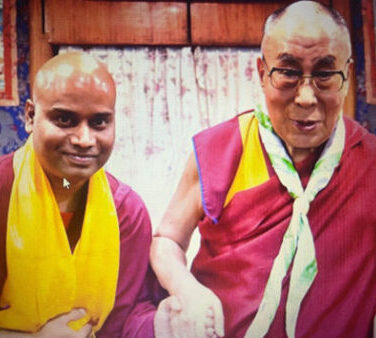
About the Teacher Geshe Tenzin Lhabsum (GomChen) is an Indian Buddhist monk from Mumbai who trained extensively in the Tibetan Buddhist tradition, with an emphasis on Buddhist philosophy, logic, epistemology, meditation and contemplative practice.
Before entering monastic life, he worked as an electronics engineer and professional sound engineer for 11 years. In 2004, he left his professional career and moved to Dharamsala, where he studied Tibetan before receiving ordination from His Holiness the Dalai Lama.
This course will be conducted in English only.
Please note- “attendance in all sessions is mandatory.”
For queries, registration & accommodation, please email: [email protected]